Table of contents
- What stop-loss and take-profit automation means
- The core problem: automation follows rules, not context
- How the workflow usually works
- Manual, copy, and bot-based risk controls compared
- Practical scenarios traders often review
- Relevant bot tools and settings
- Permissions, control, and setup considerations
- Testing bot risk settings before live use
- Final thoughts
The scary part of using a crypto trading bot is not that it can act automatically. It is that it can keep acting automatically when the market is moving fast, liquidity is thin, or your original idea is no longer valid.
That is why traders searching for crypto bot risk management stop loss take profit usually are not looking for magic settings. They are trying to understand how automated SL TP crypto workflows translate a trading plan into orders, triggers, exits, and limits that a bot can follow consistently.
This guide explains the moving parts in plain English: stop-loss logic, take-profit automation crypto traders often evaluate, trailing exits, DCA-style safety orders, and the operational checks that help keep automation from becoming autopilot.
What stop-loss and take-profit automation means
A stop-loss is a conditional exit concept. In simple terms, it is designed to close or reduce a position if price reaches a level that suggests the trade idea may be wrong. The Investopedia stop-loss order guide explains the classic purpose, while also noting that execution can differ from the stop price in real markets.
A take-profit order does the opposite job. It defines where a strategy may capture gains if price reaches a planned target. The Investopedia take-profit order guide notes that TP orders are often considered alongside stop-loss orders when traders define risk and reward.
In a bot workflow, these ideas become rules. Instead of a trader watching a chart and reacting manually, the bot monitors conditions and sends or manages orders according to the configured strategy. The key tradeoff is simple: automation can enforce a plan consistently, but it cannot decide whether the plan still makes sense.
The core problem: automation follows rules, not context
Bot risk settings are powerful because they remove hesitation. They are also risky when the rules are vague, copied without understanding, or tested only in quiet market conditions.
Crypto markets can move through gaps, fast candles, exchange-specific order rules, funding events, and sudden liquidity changes. A stop-loss may trigger later than expected, a take-profit may fill partially, or a trailing mechanism may behave differently than a trader imagined from a clean chart example.
This is why risk-aware strategy builders usually separate three questions. What invalidates the idea? What confirms enough progress to exit partially or fully? What operational limits should prevent one automated system from dominating the whole account?
Note: A bot does not reduce risk by existing. Risk control comes from the strategy logic, position sizing framework, exchange behavior, monitoring process, and the trader's willingness to review results honestly.
How the workflow usually works
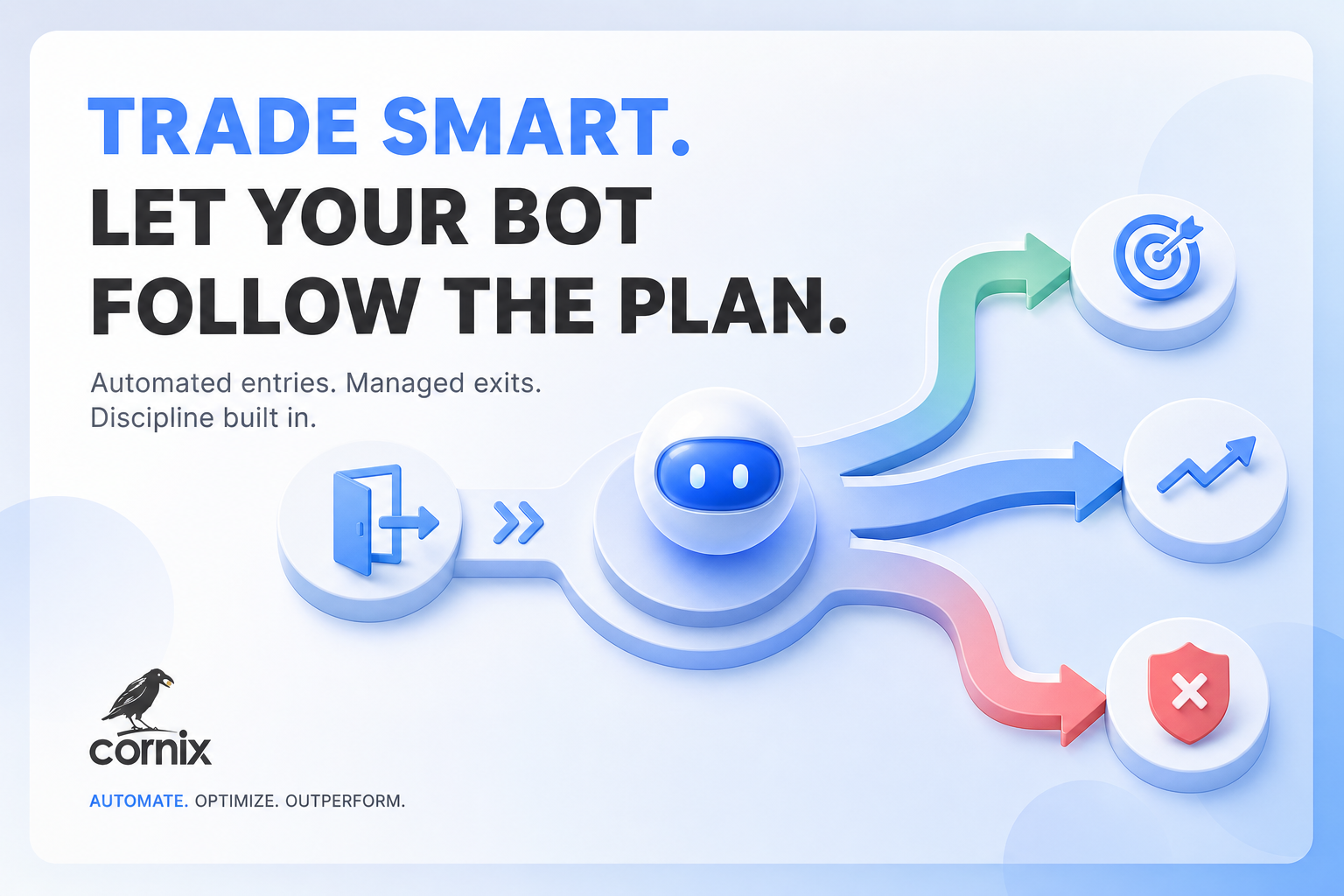
Most automated SL and TP workflows begin with an entry condition. That condition might come from a signal, a bot rule, or an external alert. Once the trade is active, the system tracks exit conditions such as fixed take-profit targets, a stop-loss trigger, or a trailing exit.
In Cornix, TradingView Bots execute trades automatically based on a pre-configured strategy when triggered by TradingView alerts connected through webhooks, and the documented creation flow includes General, Entries, Take-Profit, Stop, and Advanced steps in Create a Trading View Bot.
For signal-based workflows, the first risk question is whether the signal contains information the bot can parse correctly. Cornix documents two signal-posting methods for channel admins, Free Text signals and the Publish Signals feature, and explains that Free Text signals need to follow formatting rules so the bot can read and parse them in Signal Posting.
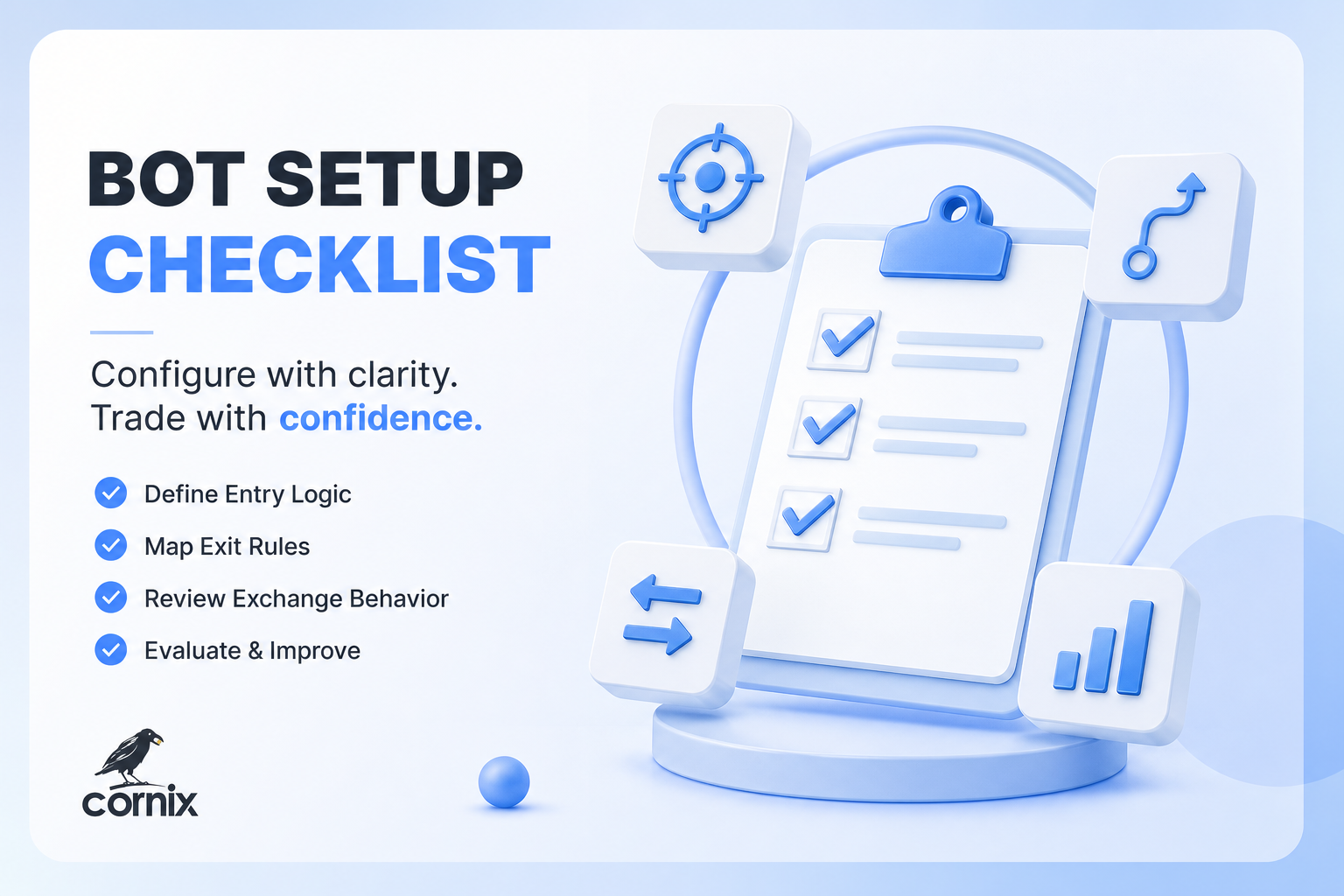
A common workflow review looks like this: entry logic first, then the planned exit map, then what happens if price moves quickly, then what happens after the trade closes. That last part matters because repeated automated trades can compound both good and bad assumptions.
Manual, copy, and bot-based risk controls compared
There is no single risk control model that fits every trader or team. Manual trading, copy-based workflows, and bot-based automation each create different operating constraints. The comparison below is not a ranking, it is a way to see what each model tends to emphasize.
Risk control models for crypto trading workflows
| Workflow model | Best for | Manual effort | Automation level | Control level | Main limitation |
|---|---|---|---|---|---|
| Manual trading | Traders who want to interpret each setup in real time | High | Low | Very direct, but depends on attention | Execution can be emotional or delayed |
| Copy or signal-based workflow | Traders who follow an external strategy source and want structured execution | Medium | Medium | Depends on signal quality and user configuration | Signal format, timing, and interpretation can create gaps |
| Bot-based automation | Strategy builders who want predefined rules executed consistently | Lower during execution, higher during review | High | Strong rule control when settings are understood | The bot follows rules even when market context changes |
| Managed multi-strategy process | Teams or advanced users reviewing several systems at once | High during governance, variable during execution | Variable | Depends on permissions, reporting, and review discipline | Complexity can hide correlated risk across strategies |
Order types also matter. The Coinbase order types overview is useful background because it explains market, limit, stop-limit, and bracket order concepts. Bot settings often combine these ideas into a repeatable workflow, but execution still depends on market and exchange conditions.
Practical scenarios traders often review
Scenario 1: a signal reaches a trader during a fast move. The entry is already close to the first target, and the stop area is not far away. In this situation, strategy builders often review whether the bot would still have enough room to execute the original plan, or whether the signal arrived too late for that specific rule set.
The key lesson is not that late signals are always unusable. It is that automated systems need clean assumptions. If the entry, take-profit, and stop-loss zones are packed tightly into a volatile candle, slippage and partial fills may become more important than the chart pattern itself.
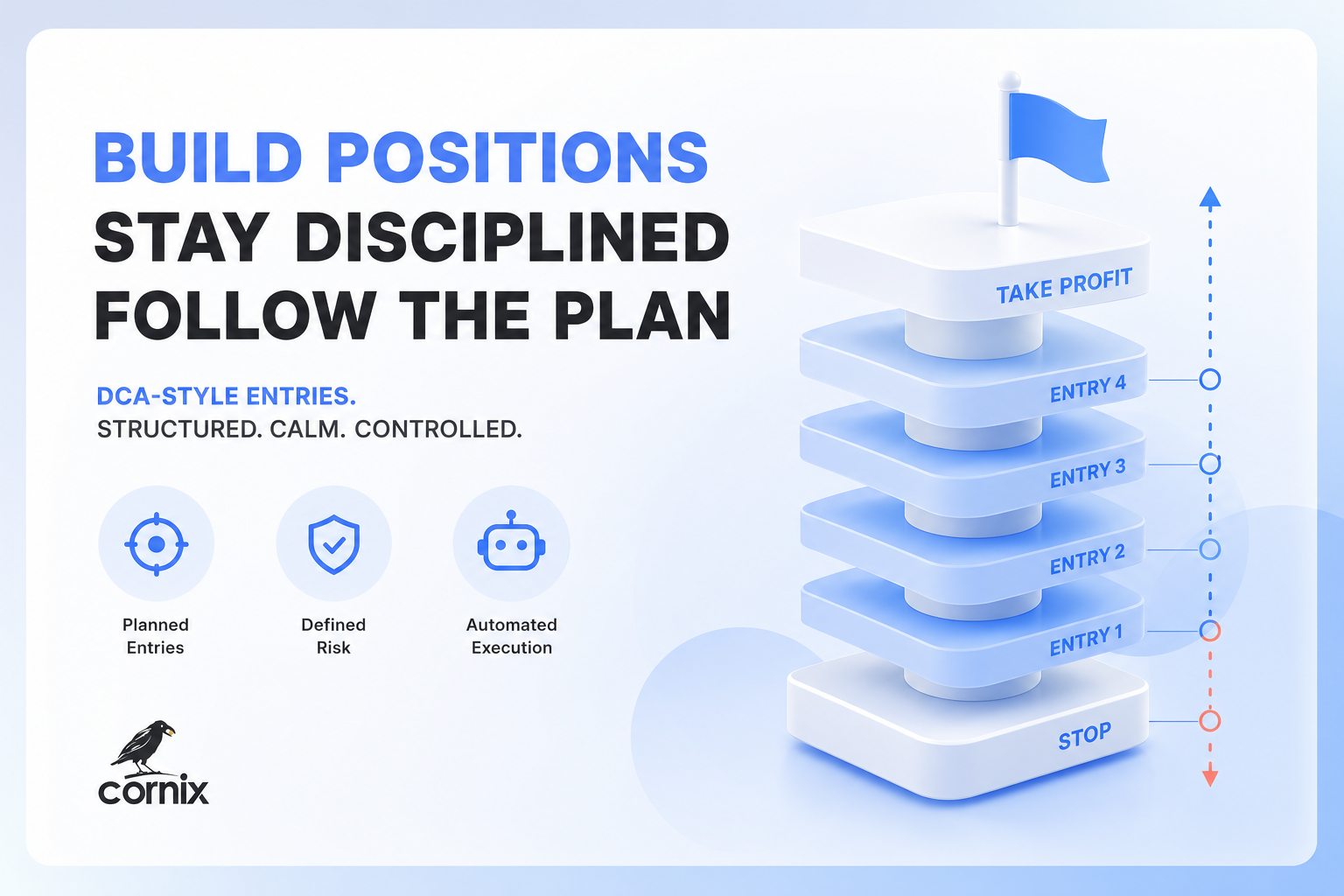
Scenario 2: a DCA-style strategy uses multiple planned entries. In the wider bot world, these later entries are often called safety orders because they are designed to change the average entry price if price moves against the initial entry. The tradeoff is that additional entries can also increase capital usage and make the final exit logic more important.
Cornix documents that the Entries step in a Smart DCA Bot sets the number of orders, their price, and their size, while the Take-Profit step sets the take-profit order and the Stop step is used for a stop-loss order and other stop settings in Create your own Smart DCA Bot.
Relevant bot tools and settings
Risk management for bots is usually built from several setting families rather than one magic switch. Strategy builders may evaluate fixed stop-loss rules, fixed take-profit targets, trailing stop behavior, trailing take-profit behavior, cooldowns, max trade counts, and DCA-style entry structure.
Trailing logic deserves extra attention because it changes as price moves. A general Investopedia trailing stop definition describes a stop that adjusts with favorable price movement while keeping a defined distance. In bot workflows, that moving behavior can be useful to model, but it also needs careful review because the exit is dynamic rather than fixed.
Cornix documents five trailing stop-loss types in its Trailing Stop-loss Help Center article: Breakeven, Moving Target, Moving 2-Target, Percent Below Triggers, and Percent Below Highest. Different strategy designs may evaluate these concepts differently, especially when targets are reached quickly or when price reverses before a trailing condition completes.
One operational detail that surprises newer automation users is that not every planned order appears on the exchange immediately. Cornix explains that with Trailing Entry or Trailing TP, the actual order may not be visible on the exchange right away and may be placed only after the relevant trailing condition is met in Why My Orders Are Not Placed on the Exchange?.
Common bot risk settings and what they are usually reviewed for
| Setting family | What it controls | Common review question | Main tradeoff |
|---|---|---|---|
| Stop-loss | Where an automated exit may trigger if price moves against the strategy | What condition would suggest the trade idea is invalid? | Can trigger during noise or execute differently in fast markets |
| Take-profit | Where an automated exit may capture a planned gain | What would count as enough progress for this strategy? | May exit before a larger move or miss if liquidity is thin |
| Trailing stop or trailing TP | How the exit may move after favorable price movement | How should the strategy behave after price moves in its favor? | Dynamic rules are harder to visualize than fixed targets |
| DCA-style additional entries | How later entries may change average entry and capital usage | How much capital could the full sequence require? | Can improve entry structure in some designs, but increases exposure |
| Cooldown or max trade count | How frequently the bot may continue after prior activity | What prevents repeated entries during unstable conditions? | Too restrictive or too permissive depends on the strategy design |
Compare automation tools calmly
If you are mapping different bot styles, the Cornix website lists feature pages for DCA Bots, Grid Bots, and TradingView Bots so you can compare workflows before thinking about live execution.
Permissions, control, and setup considerations
Before any automated system is connected to an exchange account, traders usually review permissions, account scope, and operational boundaries. This section is about control structure, not about choosing a specific exchange or asset.
A practical control review may include who can edit the bot, who can pause it, whether the account is used for one strategy or several, and how trade history will be checked. For teams, the workflow also needs a clear owner for reviewing unexpected behavior, because automation can create confusion if everyone assumes someone else is watching.
Configuration limits can also act as guardrails. Cornix documents that the Advanced step for a Smart DCA Bot can set cooldown time and the number of trades until the bot stops in Create your own Smart DCA Bot. These controls are best understood as operational limits within a broader strategy review, not as guarantees of better outcomes.
Testing bot risk settings before live use
Testing is where theory meets friction. A strategy can look tidy on a screenshot, then behave differently when price jumps past a level, several targets overlap, or a trailing order is still active when another condition is reached.
Cornix documents a Merged status that can occur when a previous trailing order is still active as the next target is reached, and the system merges the amount of the new target into the active trailing order in Order Closed Statuses. That kind of detail is exactly why testing and reviewing order history matters for automated SL TP crypto workflows.
A review process often looks at whether entries were triggered as expected, whether stop and take-profit logic matched the strategy design, whether trailing behavior was understandable, and whether repeated trades created concentration risk. The goal is not to optimize every result after the fact. It is to learn whether the rules behaved the way the trader expected.
For simulated practice, the Cornix website describes the Demo Account as a way to test automated trading without real funds on the Demo Account page. Demo testing cannot reproduce every live-market condition, but it can help users understand configuration behavior before real capital is involved.
Test the workflow first
Use a demo environment to observe how entries, stop-loss rules, take-profit logic, and trailing behavior interact before considering live execution.
Final thoughts
Crypto bot risk management is less about finding a perfect stop-loss or take-profit formula and more about building a workflow that can be understood, tested, monitored, and improved. Automation can make execution more consistent, but it also makes weak assumptions repeat faster.
If you are learning how to set stop loss on trading bot systems, the more useful question is usually: what should the bot do if the trade works, if it fails, if price moves too fast, or if several orders overlap? Clear answers to those questions create better bot risk settings than copying numbers from someone else's chart.
Cornix fits into this conversation as a configurable automation layer for traders who want to map signals, DCA structures, TradingView alerts, take-profit logic, stop settings, and trailing behavior into repeatable workflows. The important part is still the human review: understand the strategy, test the behavior, and treat automation as a tool rather than a substitute for risk awareness.
Build your risk-aware automation workflow
Explore Cornix and review how different bot workflows can support structured execution, testing, and ongoing strategy review.
Frequently Asked Questions
What is crypto bot risk management?
Crypto bot risk management is the process of defining how an automated strategy handles entries, stop-losses, take-profits, capital usage, cooldowns, and review. The bot executes rules, while the trader is responsible for understanding and monitoring those rules.
How does a stop-loss work on a crypto trading bot?
A stop-loss on a trading bot is usually a predefined exit rule that may close or reduce a trade if price reaches a certain condition. Execution can still depend on market speed, liquidity, order type, and exchange rules.
What is take profit automation crypto traders use bots for?
Take-profit automation lets a bot monitor a planned target or exit condition instead of relying on a trader to react manually. Some strategies use one target, while others use multiple targets or trailing logic.
Are automated SL TP crypto settings guaranteed to limit losses?
No. Automated stop-loss and take-profit settings can help define a plan, but they cannot guarantee execution price, profitability, or loss limits in every market condition.
What is the difference between a fixed take-profit and trailing take-profit?
A fixed take-profit is tied to a planned price or percentage condition. A trailing take-profit is dynamic, meaning the exit logic may move as price moves favorably, depending on how the strategy is configured.
What are safety orders in crypto bot strategies?
Safety orders are a common term for additional planned entries in some DCA-style bot strategies. They may change the average entry price, but they also affect capital usage and exposure, so traders usually review the full sequence before using it.
Why do some bot orders not appear on the exchange immediately?
Some automated workflows use conditional or trailing logic. In those cases, a planned order may not be placed on the exchange until the relevant trigger or trailing condition is met.
Should bot risk settings be tested before live trading?
Many traders test bot risk settings first so they can observe how entries, stop-losses, take-profits, trailing rules, and cooldowns behave. Testing does not guarantee live results, but it can reveal configuration issues.