Table of contents
- What a DCA trading bot actually does
- The benefit is a planned average entry, not a better prediction
- The risks that deserve attention before activation
- Build the setup from the failure case backward
- Test order behavior before funding the strategy
A DCA trading bot is useful when you have already decided how much capital you may commit to a trade, where additional entries belong, and when the idea is invalid. It is a poor fit when “buy more if it falls” is the entire plan. The bot can make a written averaging process repeatable, but it cannot decide whether a falling market will recover.
Cornix DCA Bots follow configurable first-entry, additional-order, take-profit, and stop rules. The practical verdict is conditional: use a DCA bot for a funded, rule-based averaging thesis with a clear exit and pause condition. Keep the trade manual, or do not take it, if you cannot state the maximum position size and the event that stops further exposure.
What a DCA trading bot actually does
Traditional dollar-cost averaging commonly means buying a fixed amount at scheduled intervals. A trading bot called “DCA” often works differently. It opens an initial position, then places or manages planned additional entries if price moves against that first entry. If price later reaches the configured exit, the bot closes the position and may begin another cycle, depending on its settings.
That distinction matters because the word DCA can make a strategy sound automatically conservative. Time-based investing spreads purchases across dates. A price-triggered DCA bot is an active trade structure: its exposure can rise as lower entries fill. Cornix documents that an active Smart DCA Bot normally has one open trade outside its cooldown period, and that a new trade can begin after a take-profit or stop closes the prior one unless advanced settings change that behavior. See Smart DCA Bot mechanics.
The benefit is consistency. You decide the order sequence and exit rules before an emotional market move, rather than improvising every time price drops. The cost is commitment. Once live, the configuration will keep following its logic until an exit, a stop condition, deactivation, or another operational event changes the path.
The benefit is a planned average entry, not a better prediction
A DCA bot can lower the average entry price if later buys fill below the first entry. That can reduce the price recovery needed to reach a given take-profit compared with buying the whole intended amount at the first price. It can also make position sizing and order placement more systematic for traders who would otherwise chase a move or hesitate during a decline.
But averaging changes the capital path, not the market’s direction. A sequence with more orders, larger later orders, or wider price spacing can produce a very different ending exposure from one that uses equal-size entries. The relevant question is not, “How many safety orders should I use?” It is, “What will this exact sequence own if every order fills?”
Cornix’s bot builder makes that question concrete. Its DCA setup separates the account, symbol, amount per trade, and, for supported futures accounts, direction, margin type, and leverage from the entries, take-profit, stop, and advanced settings. The builder also displays a dynamic order summary while you edit.
The risks that deserve attention before activation
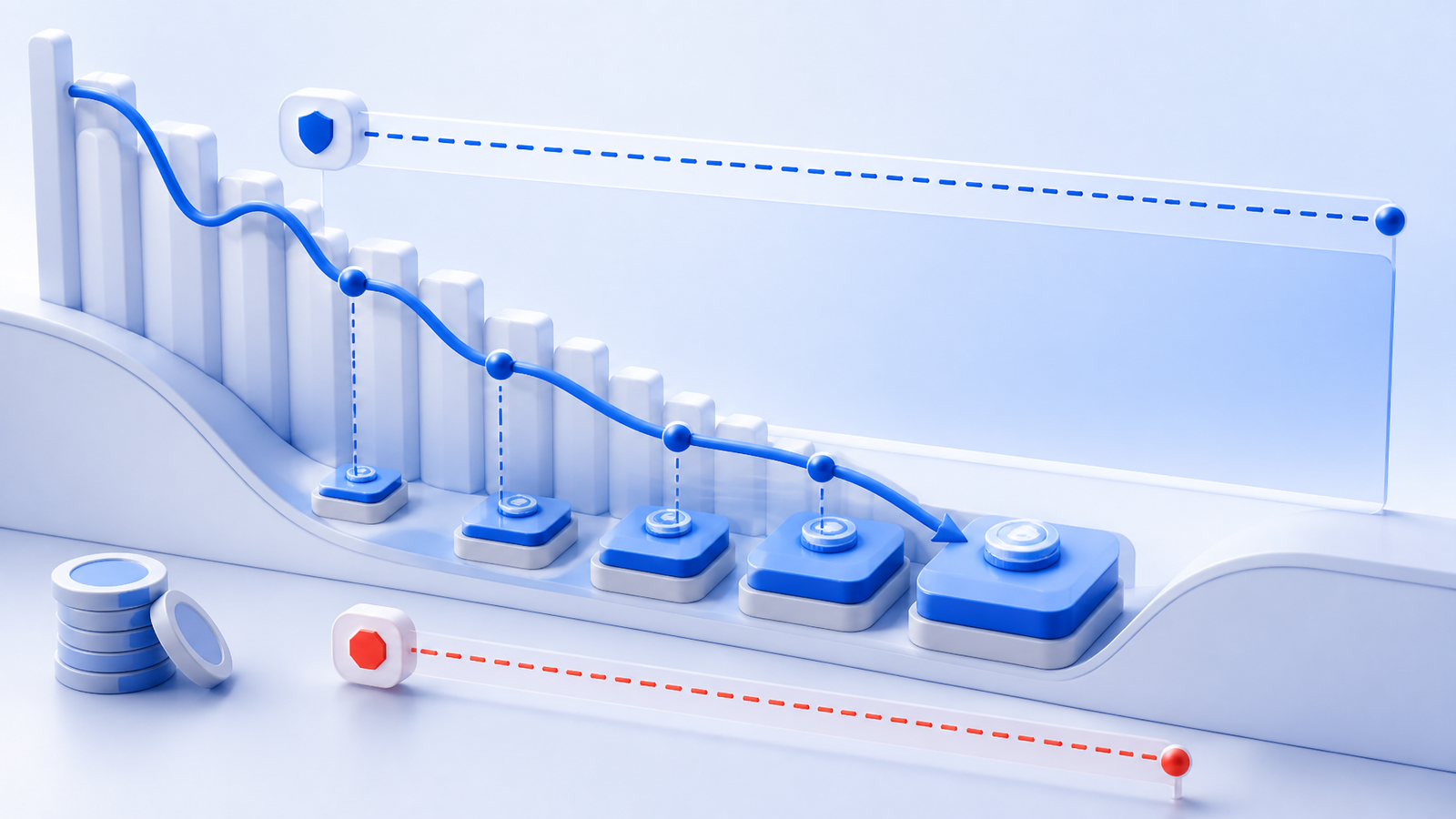
The central risk is not that an order fails to fill. It is that the bot executes exactly as configured during a sustained move that exceeds your original assumptions. Each filled additional entry can increase deployed capital and concentration in the same asset. If later entries are scaled larger, the final entries may carry much of the exposure.
A stop-loss can set a rule for closing a losing trade, but it does not guarantee a particular execution price in fast or thin markets. Fees, spreads, partial fills, exchange order rules, and leverage can change the live result from a neat chart scenario. The CFTC warns that digital-asset trading is highly volatile and that no bot, signal, algorithm, or trading strategy is guaranteed or risk-free. See CFTC digital-asset risk advisory.
Recurring behavior is another easy-to-miss risk. A bot that restarts after every close can re-enter into market conditions you no longer want to trade. Use the advanced controls deliberately. Cornix allows a cooldown after a trade closes, a cap on the number of trades before automatic deactivation, and a limit on continuous stop-loss events before the bot stops. See Smart DCA Bot setup guide.
For futures, do not treat leverage as a way to make a small plan work. It changes the size and liquidation sensitivity of the exposure. Decide whether the strategy belongs in spot or futures first, then confirm the exchange, account type, and market are supported. Cornix currently lists separate support by spot, futures, and inverse account types, with exclusions that include Binance.US, OKX.US, and OKX.EU. See supported exchange list.
Build the setup from the failure case backward
Start with the full loss and exposure scenario, not the target. Choose an amount per trade that represents the entire possible sequence, not merely the initial order. Then map the first order, the number and spacing of later entries, and whether their sizes remain even or increase. A configuration is only understandable when you can explain its total possible capital use in ordinary language.
Next, choose the exit structure. A take-profit based on the average entry can behave differently from one based on the first entry because filled additional orders change the average. A trailing exit can also behave differently from a fixed target. These are trade-design choices, not cosmetic settings. Pair them with a stop rule that reflects the point at which the original thesis has failed.
Finally, set the operating boundary. Decide whether the bot should immediately seek a new trade after a close, wait through a cooldown, or stop after a defined number of cycles. A DCA bot is often most dangerous when it keeps running after the market regime that justified it has changed.
Test order behavior before funding the strategy
Test the complete workflow with simulated funds before treating a DCA bot as live-ready. The goal is not to prove that the strategy will make money. It is to confirm that the symbol, exchange account, sizing, additional-entry path, take-profit, stop, and restart behavior work as you expect.
Cornix’s built-in Demo Account uses simulated funds and real-time market data, supports DCA bots, and does not require an exchange API connection. It is useful for observing how a configuration responds to normal movement and an awkward path, such as several entries filling quickly. It cannot reproduce every live-market effect, including real liquidity, fills, or future performance.
After activation, monitor the active trade rather than relying only on accumulated profit or loss. Cornix’s DCA bot view shows the last filled entry plus the next entry, stop, and take-profit orders, while the active-trade timeline exposes order-level details. It also notes that certain non-regular trade closures automatically deactivate the related bot. See DCA monitoring guide. That is a reason to build a review routine around order states and exceptions, not just a periodic return check.
Selection principle: choose a DCA trading bot only when you can fund every configured entry, accept the resulting exposure, and explain both the exit and the condition for pausing the system. If you want to practice that workflow first, Launch a DCA bot.
Frequently Asked Questions
Is a DCA trading bot the same as regular dollar-cost averaging?
Not necessarily. Regular DCA usually means investing a fixed amount on a schedule. A DCA trading bot may instead use price-triggered additional entries, a take-profit, a stop-loss, and repeat-cycle rules. That makes it an active trading workflow rather than simply periodic investing.
Can a DCA bot lose money?
Yes. Additional entries can increase total exposure as price falls, and a stop may execute at a different price than expected in a fast market. A bot enforces configured rules, but it cannot guarantee recovery, profitable exits, or a limit on loss beyond how orders are actually handled.
How much money should I allocate to a DCA bot?
Base the amount on the total possible capital use if every planned entry fills, not on the first order alone. Then consider fees, other open positions, and whether the loss at the stop level fits your broader risk limit. Avoid funding a sequence you cannot complete.
Should I copy a public DCA bot?
Only after reviewing and adapting its full configuration. Cornix lets users inspect a shared bot’s configuration, select an account, edit advanced settings, and create it inactive or activate it. Historical results and another trader’s settings do not establish that the capital path fits your account or market view. See bot-sharing workflow.