Table of contents
- Verify the evidence before the marketing
- Read downside before win rate
- Check the trade history as a sequence
- Match the provider to your exchange and account
- Test how updates reach followers
- Decide whether automation is appropriate
Choose a crypto signal provider only if it can show a complete, time-stamped record, explain its downside and costs, and fit the exchange account and execution rules you will actually use. A high win rate, a recent winning streak, or a polished Telegram feed is not enough. If the provider cannot answer the checks below clearly, keep the workflow manual or walk away.
Verify the evidence before the marketing
Start with the record, not the headline return. Ask for a history covering both favorable and difficult market conditions, with every opened, edited, canceled, and closed signal included. A short run of winners says little about how a provider behaves through losses, late entries, or a changing market regime.
Separate actual results from backtests, paper trades, and selectively shared examples. The CFTC cautions that hypothetical results have inherent limitations and may not reflect live conditions such as liquidity or a trader's ability to withstand losses. Past performance is not a forecast either. CFTC guidance on hypothetical results
Use this evidence checklist:
- Duration: Is there a continuous history long enough to include losing periods, not only a recent campaign?
- Completeness: Can you inspect losers, canceled calls, edits, and open positions, not just closed winners?
- Timing: Are original posts and later updates time-stamped and visible in sequence?
- Method: Is each result labeled live, simulated, backtested, or reconstructed?
- Measurement: Does the provider explain whether figures are gross or net of subscription fees, exchange fees, funding, and slippage?
Do not treat screenshots as an audit trail. Ask whether results assume an entry that followers could realistically receive, whether leverage is included, and how partial fills are handled. Fees reduce the amount of capital that remains invested, so a provider's headline return is not the return your account necessarily receives.
Read downside before win rate
Win rate answers only one narrow question: how often reported trades won. It does not tell you the size of losing trades, the amount committed to each setup, or whether a few losses can erase many small gains.
Ask for the largest peak-to-trough decline in the reported account or strategy, commonly called drawdown, plus the largest loss on a single idea and the longest losing streak. Then ask what risk rule was used for each trade: fixed allocation, a percentage of the account, or a loss amount defined by the stop distance. If the provider uses leverage, clarify whether the figures describe price movement, position exposure, or account-level gain and loss.
A useful provider can explain its operating boundaries in plain language: which assets it covers, whether it trades spot or derivatives, how many positions may be open, and what makes an idea invalid. Vague language such as “risk managed” is not a substitute for a stop level, sizing rule, and a clear explanation of what changes after a losing run.
Check the trade history as a sequence

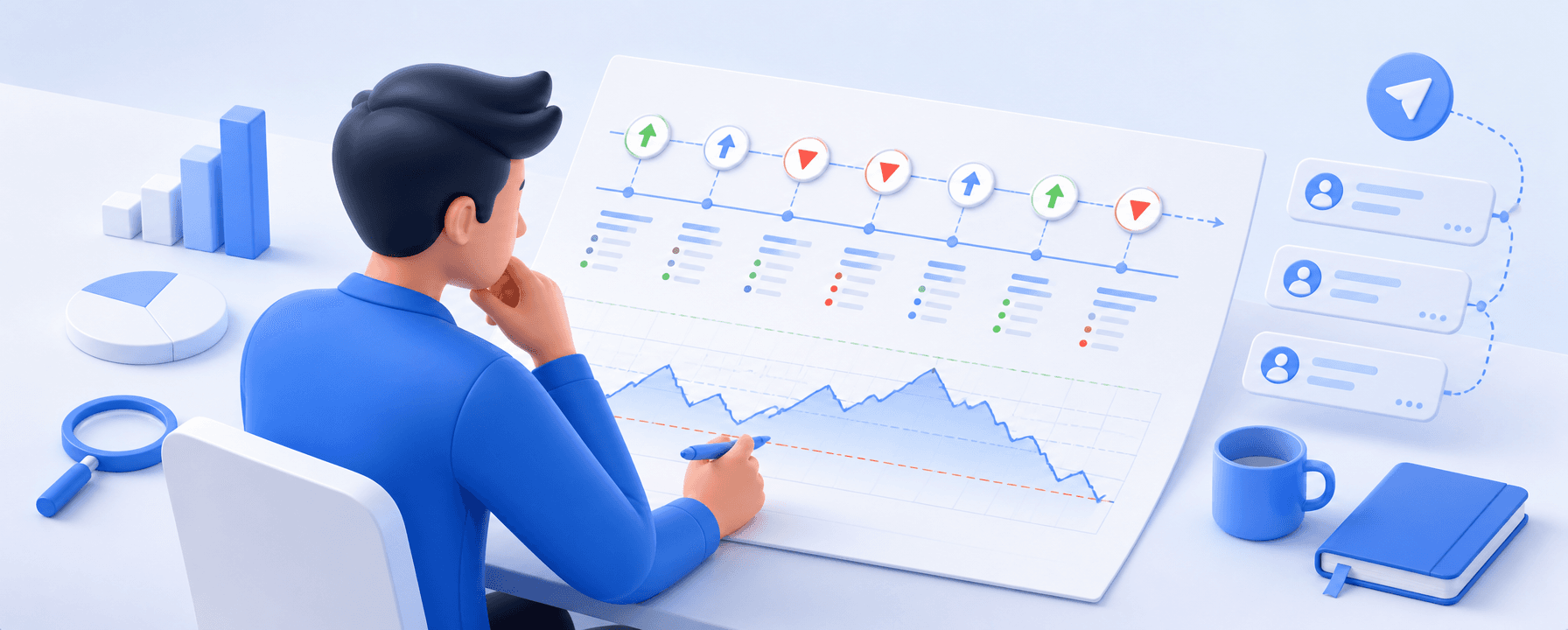
A real signal workflow is more than an entry and an exit. Review several complete examples from start to finish. You should be able to see the pair, direction, entry zone, take-profit targets, stop level, leverage if relevant, timestamps, and every update.
This matters because a signal is a recommendation, while the trade is the actual set of exchange orders created from it. A provider's post can include entries, targets, stops, and advanced conditions, but your result still depends on your connected account, settings, available balance, and market execution. Cornix signals and trades guide
Pick three examples: a winner, a loser, and a trade that needed adjustment. For each, ask:
1. When was the original setup posted relative to the entry?
2. Were targets or the stop changed, and why?
3. Did the provider close, cancel, or add to the position?
4. Could a new subscriber have acted at the same point?
5. Does the reported outcome include every entry and exit?
A channel that shows only end results leaves you unable to judge the process that produced them.
Match the provider to your exchange and account
A sound strategy can still be a poor operational fit. Confirm the exact exchange, market type, pair format, and account type used by the provider. A spot signal may not translate cleanly to a derivatives account. A pair might be unavailable in your region or unsupported on your selected exchange account. Minimum order sizes, leverage settings, and available balances can also change what reaches the market.
Before subscribing, write down the provider's usual pairs, long or short bias, spot or futures focus, typical number of entries, stop-loss practice, and use of leverage. Then compare those details with your own account and constraints. On Cornix, Signals Bot settings can filter symbols and set direction, leverage, exchange account, and amount per trade. Signals Bot general settings
Do not assume a channel's default allocation fits you. The right question is whether you can set a smaller, explicit limit that still makes each order valid for your exchange.
Test how updates reach followers
Telegram trading signals are not static. Providers may revise entries, targets, stops, or close a setup. Ask what followers should expect when this happens and whether the provider announces the reason for material changes.
For Cornix auto-trading users, edits and closures to an active signal can be applied automatically to trades that were opened through Signals Bot auto-trading. Trades opened manually or through the follow button need updates applied manually. Cornix signal update handling That difference makes update handling a decision point, not a minor technical detail.
Also verify that the channel is actually compatible with the workflow you plan to use. Cornix-supported channels display follow controls, while a Telegram channel without those controls cannot be auto-traded through Cornix. Cornix Marketplace can help members browse integrated channels by exchange, pricing, and risk level, but Cornix also advises researching a channel independently. Cornix channel joining guide
Decide whether automation is appropriate
Automation should come after due diligence, not replace it. First, paper-log a sample of signals without placing orders, then compare each original post with the orders you would have placed. This reveals whether entry zones are practical, whether updates arrive in time, and whether the provider's pace matches your ability to monitor it.
If you later automate, configure personal boundaries first: allowed pairs, account, amount per trade, direction, leverage, stop behavior, and a limit on concurrent exposure. Cornix documents separate Signals Bot settings for these choices and advanced rules intended to control trade volume and execution behavior. Signals Bot advanced settings
Crypto trading, including automated trading, involves substantial risk. Automation does not prevent losses, slippage, failed execution, or liquidation. This content is educational and is not financial advice.
The selection principle is simple: choose the provider with the clearest complete record and the most compatible process, not the most exciting claimed return. When those checks hold, use Set up a limited Signals Bot workflow to map a supported channel to a deliberately limited Signals Bot setup before enabling auto-trading.
Frequently Asked Questions
What is the most important thing to verify in a crypto signal provider?
Verify a complete, chronological trade record that includes losing, canceled, edited, and open signals. Then confirm whether the results are live or hypothetical and whether reported returns include relevant costs.
How can I verify Telegram trading signals?
Review original time-stamped posts and subsequent updates, then compare a few full signal sequences with the exchange orders you could have placed. Check the pair, entry, stop, targets, leverage, and final close rather than relying on recap images.
Are win rates enough to choose a crypto signals channel?
No. Win rate does not show loss size, drawdown, leverage, position sizing, or whether results include all updates and costs. Review downside and the complete record alongside it.
Can I automate a signal channel immediately after joining?
Only after confirming that the channel is supported, the exchange and pairs fit your account, and your own bot limits are set. A supported Cornix channel can be connected to a Signals Bot, but automation does not make a provider suitable for your risk tolerance or account.