
Table of contents
- The decision in one table
- Grid bots need crossings, not simply volatility
- DCA bots need a defined averaging path
- Fees and exits change the practical answer
- Choose by the failure mode you can tolerate
- Test the mechanism before evaluating the strategy
A grid bot vs. DCA bot decision is really a decision about the price path you expect and the exposure you are willing to hold while that expectation is tested. A grid bot may fit when your thesis depends on repeated movement back and forth inside defined boundaries. A DCA bot may fit when your thesis is to build an average entry through planned buys as price falls, then exit on a configured recovery. Neither structure is a universal winner, and neither turns automation into a return guarantee.
In this comparison, DCA bot means a Cornix Smart DCA bot: it opens a trade, adds configured entries as price moves against the position, and closes according to take-profit or stop rules. Traditional DCA instead divides purchases across scheduled intervals regardless of price. The examples below assume a long bot; short futures configurations reverse the direction of the entries and exit. Smart DCA bot overview
Crypto markets are volatile, and leverage can amplify losses. The CFTC also cautions against automated-trading promotions that imply high or guaranteed returns. Treat either bot as an execution structure that needs a written risk boundary, enough capital for the full sequence, and ongoing review. CFTC automated trading bot advisory
The decision in one table
| Bot | Market thesis | Capital path | Exit or recycling logic | Primary failure mode |
|---|---|---|---|---|
| Grid bot | Repeated movement inside a range | Distributed across price levels | Opposite orders seek to complete cycles between grid levels | A one-way breakout can leave position exposure behind |
| DCA bot | Planned averaging after declines | Adds entries through a trade | The combined position closes at its configured exit or stop | Exposure grows through a move beyond the planned path |
The important distinction is not whether both bots buy and sell automatically. It is what must happen after entry for the structure to make sense. A grid seeks completed cycles between levels. A DCA sequence seeks a recovery sufficient to close the accumulated position at its configured exit.
Grid bots need crossings, not simply volatility
A grid bot divides a chosen price range into multiple levels that can act as buy or sell points. Cornix documents that the lowest grid is buy-only and the highest grid is sell-only; in the default setup, levels use equal price differences.
That mechanism makes a grid a study of two-way movement. Imagine a market repeatedly moving between $90 and $110. A bot with several levels can respond as price crosses them, rather than needing to predict one final direction. If price only climbs out of the upper boundary or falls through the lower boundary, the original range thesis no longer describes the market.
Configuration burden is concentrated at the start: choose the range, number of grids, amount, and, where relevant, direction, margin type, and multiplier. Advanced Cornix settings also allow arithmetic spacing, geometric percentage spacing, or custom levels. advanced grid settings
Position exposure is the grid tradeoff. On activation, a Cornix long grid can immediately buy the grids above the current market price, creating an initial amount before later crossings occur. That means a grid is not merely a set of resting orders. It can begin with exposure whose value changes if price trends away from the range. Grid bot setup guide
For a deeper explanation of range behavior, order cycles, and execution costs, read the Cornix crypto grid bot guide.
DCA bots need a defined averaging path
In the long-bot configuration discussed here, a DCA bot starts a trade, then uses configured additional entries as price moves down before attempting a take-profit or stop-based close. Cornix states that an active DCA bot normally has one open trade, excluding cooldown time, and can create another trade after a close unless its advanced settings say otherwise. Smart DCA bot overview
This structure fits a different hypothesis: “I can define in advance how I will add exposure if price declines, and I have a specific exit and stop plan.” It does not mean every falling market should be averaged. The drawdown path can deepen as additional entries fill, while capital committed to the sequence rises.
In Cornix, DCA setup separates general settings from entries, take-profit, stop, and advanced controls. The entries step specifies the number, price, and size of orders, while the advanced step can set cooldown time and the number of trades before the bot stops.
A compact example makes the distinction clearer. Suppose a trader allocates a total of $1,000. A grid distributes that potential capital across defined price levels in a range. A DCA bot might allocate part to the first market entry and reserve the rest for lower configured entries. The first structure needs price to revisit levels; the second needs the trader to accept the possibility that more capital is deployed before a recovery. The figures describe mechanics, not expected results.
Fees and exits change the practical answer
Both strategies can generate many order events, so fees and execution matter. With a grid, a completed buy-sell cycle must be assessed after applicable trading costs, not just by the distance between levels. Tighter grids can create more potential crossings, but each completed cycle has less room to absorb costs. Wider grids create more distance, but price must travel farther to complete the opposite side.
With DCA, the central question is less about cycle frequency and more about the entire position: how much is committed after every planned entry, where the average entry sits, and whether the exit and stop rules still fit the original risk limit. A take-profit can close the trade, while a stop can define a loss boundary, but neither guarantees an execution price in a fast or thin market.
Do not judge a grid only by realized results from filled take-profit orders. Cornix distinguishes realized PnL from the active trade's estimated PnL and shows grid-specific PnL alongside matched orders. grid bot monitoring guide For DCA, monitor the active trade timeline, the last filled entry, the next entry, stop, and take-profit orders, rather than treating a headline total as the whole exposure story. DCA bot monitoring guide
Choose by the failure mode you can tolerate
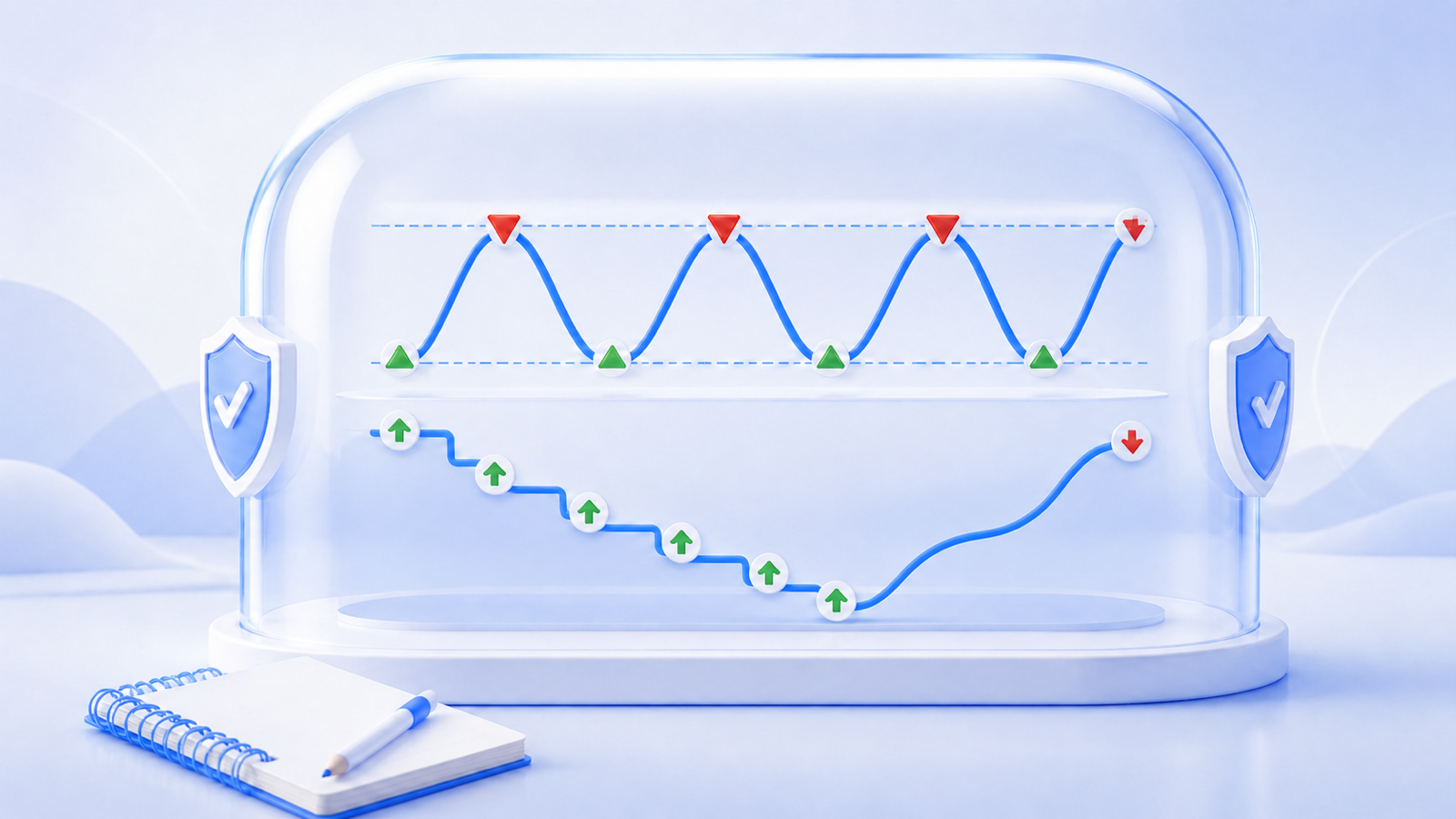
A grid bot may fit when you can state a defensible range, explain why repeated crossings are plausible, and define what you will do if price leaves that range. Its failure mode is a directional move that reduces the relevance of the level structure and can leave position exposure behind.
A DCA bot may fit when you can predefine each additional entry, fund the full sequence, and state when averaging must stop. Its failure mode is not simply that price falls. It is that the strategy keeps adding exposure into a move that exceeds the capital or risk assumptions behind the sequence.
For either choice, avoid copying settings because their past chart looks attractive. Cornix allows users to copy DCA bots, but copied configurations can be edited before creation. That is a useful reminder that an imported structure still needs to fit your exchange account, amount per trade, market, and risk limits. public DCA bots guide
Test the mechanism before evaluating the strategy
Use a test that checks behavior, not a short run of returns. First, record the range and grid count, or every DCA entry, size, take-profit, stop, and maximum capital use. Then watch one ordinary path and one awkward one: a rapid move through levels, an unfilled order, or a price move beyond the planned range or final entry.
Cornix's Demo Account is a simulated environment with real-time market data and supports Grid and DCA bots, letting users configure and monitor them without depositing real funds. It can help reveal configuration assumptions, but it cannot prove live fills, future performance, or the outcome of a real market move.
The selection principle is simple: study a grid bot for a range-and-crossings thesis, or a DCA bot for a planned averaging-and-exit thesis. If you cannot describe the capital path and the stop condition in plain language, narrow the setup or keep the trade manual.
To compare the configurable structures directly, explore the Cornix Grid Bots and DCA Bots pages.
Frequently Asked Questions
Is a grid bot better than a DCA bot?
Not universally. A grid bot fits a bounded, two-way price thesis; a DCA bot fits a planned sequence of entries after declines and a configured exit. The better choice is the one whose capital path and invalidation rule you can fund and monitor.
Can a grid bot lose money in a trending market?
Yes. A grid structure is built around levels in a chosen range. If price moves directionally away from that range, remaining position exposure and the original level structure can become the central risk rather than completed cycles.
Does a DCA bot reduce risk automatically?
No. Splitting entries changes the average-entry path, but additional filled entries increase deployed capital and exposure. Review the total potential trade amount, stop logic, and the conditions that should deactivate the bot. Smart DCA bot setup guide
Should I test grid and DCA bots before live trading?
Yes. A simulated test can help you inspect configuration, order states, and monitoring habits. Cornix's Demo Account supports both bot types with simulated funds, but it is not evidence of future results or live execution quality. Demo Account guide